 Add to Chrome
 Add to Firefox
 Add to Edge
Are AI Capabilities Increasing Exponentially? A Competing Hypothesis
Feb 04, 2026
Rapidly increasing AI capabilities have substantial real-world consequences, ranging from AI safety concerns to labor market consequences. The Model Evaluation & Threat Research (METR) report argues that AI capabilities have exhibited exponential growth since 2019. In this note, we argue that the data does not support exponential growth, even in shorter-term horizons. Whereas the METR study claims that fitting sigmoid/logistic curves results in inflection points far in the future, we fit a sigmoid curve to their current data and find that the inflection point has already passed. In addition, we propose a more complex model that decomposes AI capabilities into base and reasoning capabilities, exhibiting individual rates of improvement. We prove that this model supports our hypothesis that AI capabilities will exhibit an inflection point in the near future. Our goal is not to establish a rigorous forecast of our own, but to highlight the fragility of existing forecasts of exponential growth.

Purely Agentic Black-Box Optimization for Biological Design
Jan 29, 2026Many key challenges in biological design-such as small-molecule drug discovery, antimicrobial peptide development, and protein engineering-can be framed as black-box optimization over vast, complex structured spaces. Existing methods rely mainly on raw structural data and struggle to exploit the rich scientific literature. While large language models (LLMs) have been added to these pipelines, they have been confined to narrow roles within structure-centered optimizers. We instead cast biological black-box optimization as a fully agentic, language-based reasoning process. We introduce Purely Agentic BLack-box Optimization (PABLO), a hierarchical agentic system that uses scientific LLMs pretrained on chemistry and biology literature to generate and iteratively refine biological candidates. On both the standard GuacaMol molecular design and antimicrobial peptide optimization tasks, PABLO achieves state-of-the-art performance, substantially improving sample efficiency and final objective values over established baselines. Compared to prior optimization methods that incorporate LLMs, PABLO achieves competitive token usage per run despite relying on LLMs throughout the optimization loop. Beyond raw performance, the agentic formulation offers key advantages for realistic design: it naturally incorporates semantic task descriptions, retrieval-augmented domain knowledge, and complex constraints. In follow-up in vitro validation, PABLO-optimized peptides showed strong activity against drug-resistant pathogens, underscoring the practical potential of PABLO for therapeutic discovery.
Conformal Constrained Policy Optimization for Cost-Effective LLM Agents
Nov 14, 2025While large language models (LLMs) have recently made tremendous progress towards solving challenging AI problems, they have done so at increasingly steep computational and API costs. We propose a novel strategy where we combine multiple LLM models with varying cost/accuracy tradeoffs in an agentic manner, where models and tools are run in sequence as determined by an orchestration model to minimize cost subject to a user-specified level of reliability; this constraint is formalized using conformal prediction to provide guarantees. To solve this problem, we propose Conformal Constrained Policy Optimization (CCPO), a training paradigm that integrates constrained policy optimization with off-policy reinforcement learning and recent advances in online conformal prediction. CCPO jointly optimizes a cost-aware policy (score function) and an adaptive threshold. Across two multi-hop question answering benchmarks, CCPO achieves up to a 30% cost reduction compared to other cost-aware baselines and LLM-guided methods without compromising reliability. Our approach provides a principled and practical framework for deploying LLM agents that are significantly more cost-effective while maintaining reliability.
A Fast, Reliable, and Secure Programming Language for LLM Agents with Code Actions
Jun 13, 2025Modern large language models (LLMs) are often deployed as agents, calling external tools adaptively to solve tasks. Rather than directly calling tools, it can be more effective for LLMs to write code to perform the tool calls, enabling them to automatically generate complex control flow such as conditionals and loops. Such code actions are typically provided as Python code, since LLMs are quite proficient at it; however, Python may not be the ideal language due to limited built-in support for performance, security, and reliability. We propose a novel programming language for code actions, called Quasar, which has several benefits: (1) automated parallelization to improve performance, (2) uncertainty quantification to improve reliability and mitigate hallucinations, and (3) security features enabling the user to validate actions. LLMs can write code in a subset of Python, which is automatically transpiled to Quasar. We evaluate our approach on the ViperGPT visual question answering agent, applied to the GQA dataset, demonstrating that LLMs with Quasar actions instead of Python actions retain strong performance, while reducing execution time when possible by 42%, improving security by reducing user approval interactions when possible by 52%, and improving reliability by applying conformal prediction to achieve a desired target coverage level.
Alignment of large language models with constrained learning
May 26, 2025We study the problem of computing an optimal large language model (LLM) policy for a constrained alignment problem, where the goal is to maximize a primary reward objective while satisfying constraints on secondary utilities. Despite the popularity of Lagrangian-based LLM policy search in constrained alignment, iterative primal-dual methods often fail to converge, and non-iterative dual-based methods do not achieve optimality in the LLM parameter space. To address these challenges, we employ Lagrangian duality to develop an iterative dual-based alignment method that alternates between updating the LLM policy via Lagrangian maximization and updating the dual variable via dual descent. In theory, we characterize the primal-dual gap between the primal value in the distribution space and the dual value in the LLM parameter space. We further quantify the optimality gap of the learned LLM policies at near-optimal dual variables with respect to both the objective and the constraint functions. These results prove that dual-based alignment methods can find an optimal constrained LLM policy, up to an LLM parametrization gap. We demonstrate the effectiveness and merits of our approach through extensive experiments conducted on the PKU-SafeRLHF dataset.
Effective Reinforcement Learning for Reasoning in Language Models
May 22, 2025Reinforcement learning (RL) has emerged as a promising strategy for improving the reasoning capabilities of language models (LMs) in domains such as mathematics and coding. However, most modern RL algorithms were designed to target robotics applications, which differ significantly from LM reasoning. We analyze RL algorithm design decisions for LM reasoning, for both accuracy and computational efficiency, focusing on relatively small models due to computational constraints. Our findings are: (i) on-policy RL significantly outperforms supervised fine-tuning (SFT), (ii) PPO-based off-policy updates increase accuracy instead of reduce variance, and (iii) removing KL divergence can lead to more concise generations and higher accuracy. Furthermore, we find that a key bottleneck to computational efficiency is that the optimal batch sizes for inference and backpropagation are different. We propose a novel algorithm, DASH, that performs preemptive sampling (i.e., sample a large batch and accumulate gradient updates in small increments), and gradient filtering (i.e., drop samples with small advantage estimates). We show that DASH reduces training time by 83% compared to a standard implementation of GRPO without sacrificing accuracy. Our findings provide valuable insights on designing effective RL algorithms for LM reasoning.
Evaluating the Diversity and Quality of LLM Generated Content
Apr 16, 2025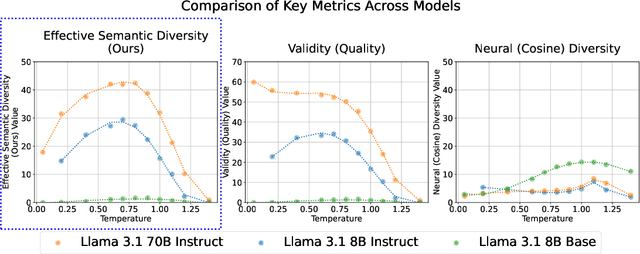
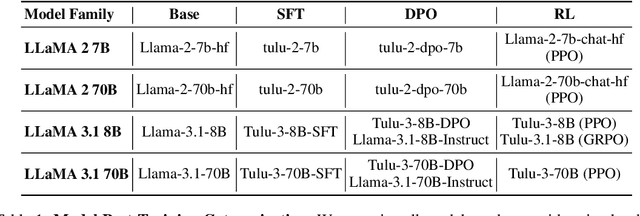
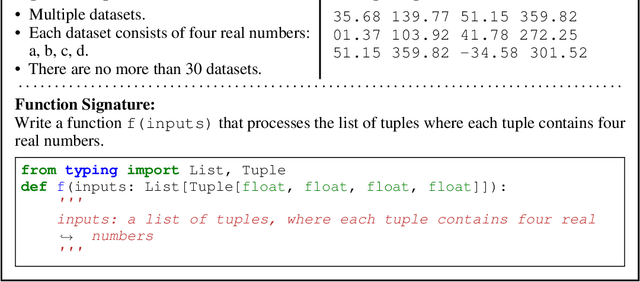
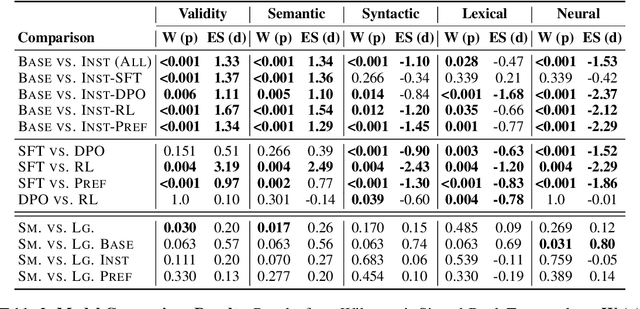
Recent work suggests that preference-tuning techniques--including Reinforcement Learning from Human Preferences (RLHF) methods like PPO and GRPO, as well as alternatives like DPO--reduce diversity, creating a dilemma given that such models are widely deployed in applications requiring diverse outputs. To address this, we introduce a framework for measuring effective semantic diversity--diversity among outputs that meet quality thresholds--which better reflects the practical utility of large language models (LLMs). Using open-ended tasks that require no human intervention, we find counterintuitive results: although preference-tuned models--especially those trained via RL--exhibit reduced lexical and syntactic diversity, they produce greater effective semantic diversity than SFT or base models, not from increasing diversity among high-quality outputs, but from generating more high-quality outputs overall. We discover that preference tuning reduces syntactic diversity while preserving semantic diversity--revealing a distinction between diversity in form and diversity in content that traditional metrics often overlook. Our analysis further shows that smaller models are consistently more parameter-efficient at generating unique content within a fixed sampling budget, offering insights into the relationship between model scaling and diversity. These findings have important implications for applications that require diverse yet high-quality outputs, from creative assistance to synthetic data generation.
Large Scale Multi-Task Bayesian Optimization with Large Language Models
Mar 11, 2025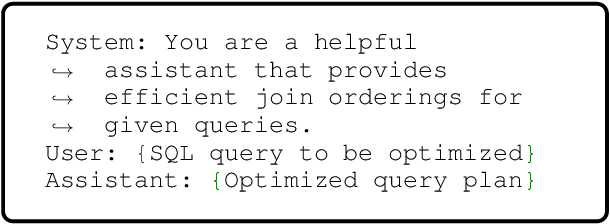
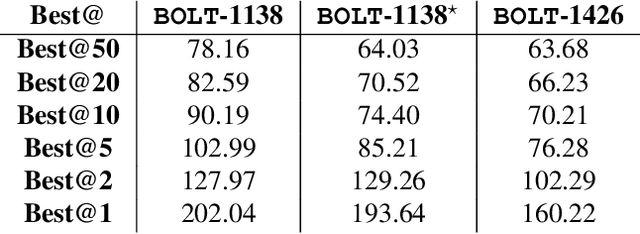
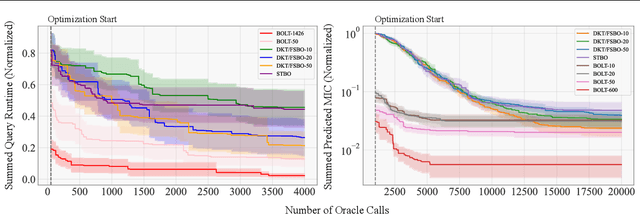
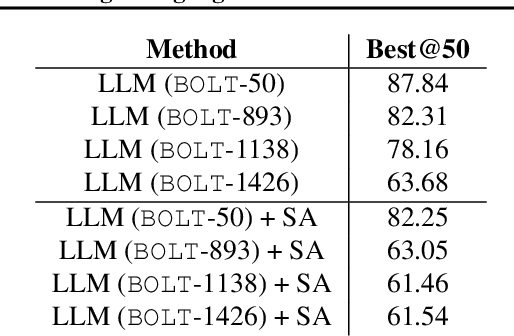
In multi-task Bayesian optimization, the goal is to leverage experience from optimizing existing tasks to improve the efficiency of optimizing new ones. While approaches using multi-task Gaussian processes or deep kernel transfer exist, the performance improvement is marginal when scaling to more than a moderate number of tasks. We introduce a novel approach leveraging large language models (LLMs) to learn from, and improve upon, previous optimization trajectories, scaling to approximately 2000 distinct tasks. Specifically, we propose an iterative framework in which an LLM is fine-tuned using the high quality solutions produced by BayesOpt to generate improved initializations that accelerate convergence for future optimization tasks based on previous search trajectories. We evaluate our method on two distinct domains: database query optimization and antimicrobial peptide design. Results demonstrate that our approach creates a positive feedback loop, where the LLM's generated initializations gradually improve, leading to better optimization performance. As this feedback loop continues, we find that the LLM is eventually able to generate solutions to new tasks in just a few shots that are better than the solutions produced by "from scratch" by Bayesian optimization while simultaneously requiring significantly fewer oracle calls.
LLM Program Optimization via Retrieval Augmented Search
Jan 31, 2025
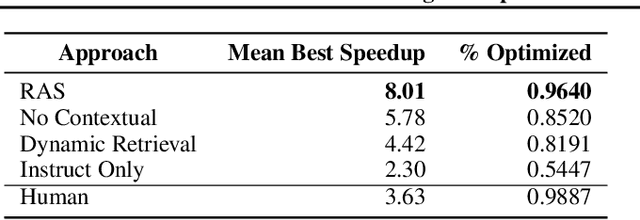

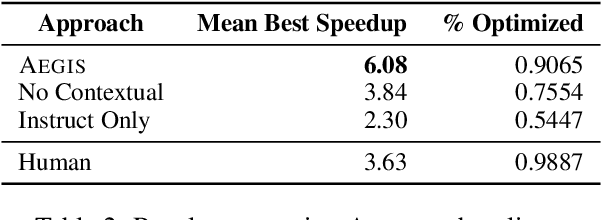
With the advent of large language models (LLMs), there has been a great deal of interest in applying them to solve difficult programming tasks. Recent work has demonstrated their potential at program optimization, a key challenge in programming languages research. We propose a blackbox adaptation method called Retrieval Augmented Search (RAS) that performs beam search over candidate optimizations; at each step, it retrieves in-context examples from a given training dataset of slow-fast program pairs to guide the LLM. Critically, we find that performing contextual retrieval based on an LLM-generated natural language description significantly outperforms retrieval based on the source code. In addition, we propose a method called AEGIS for improving interpretability by decomposing training examples into "atomic edits" that are significantly more incremental in nature. We show that RAS performs 1.8$\times$ better than prior state-of-the-art blackbox adaptation strategies, and that AEGIS performs 1.37$\times$ better while performing significantly smaller edits.
Diversity By Design: Leveraging Distribution Matching for Offline Model-Based Optimization
Jan 30, 2025

The goal of offline model-based optimization (MBO) is to propose new designs that maximize a reward function given only an offline dataset. However, an important desiderata is to also propose a diverse set of final candidates that capture many optimal and near-optimal design configurations. We propose Diversity in Adversarial Model-based Optimization (DynAMO) as a novel method to introduce design diversity as an explicit objective into any MBO problem. Our key insight is to formulate diversity as a distribution matching problem where the distribution of generated designs captures the inherent diversity contained within the offline dataset. Extensive experiments spanning multiple scientific domains show that DynAMO can be used with common optimization methods to significantly improve the diversity of proposed designs while still discovering high-quality candidates.